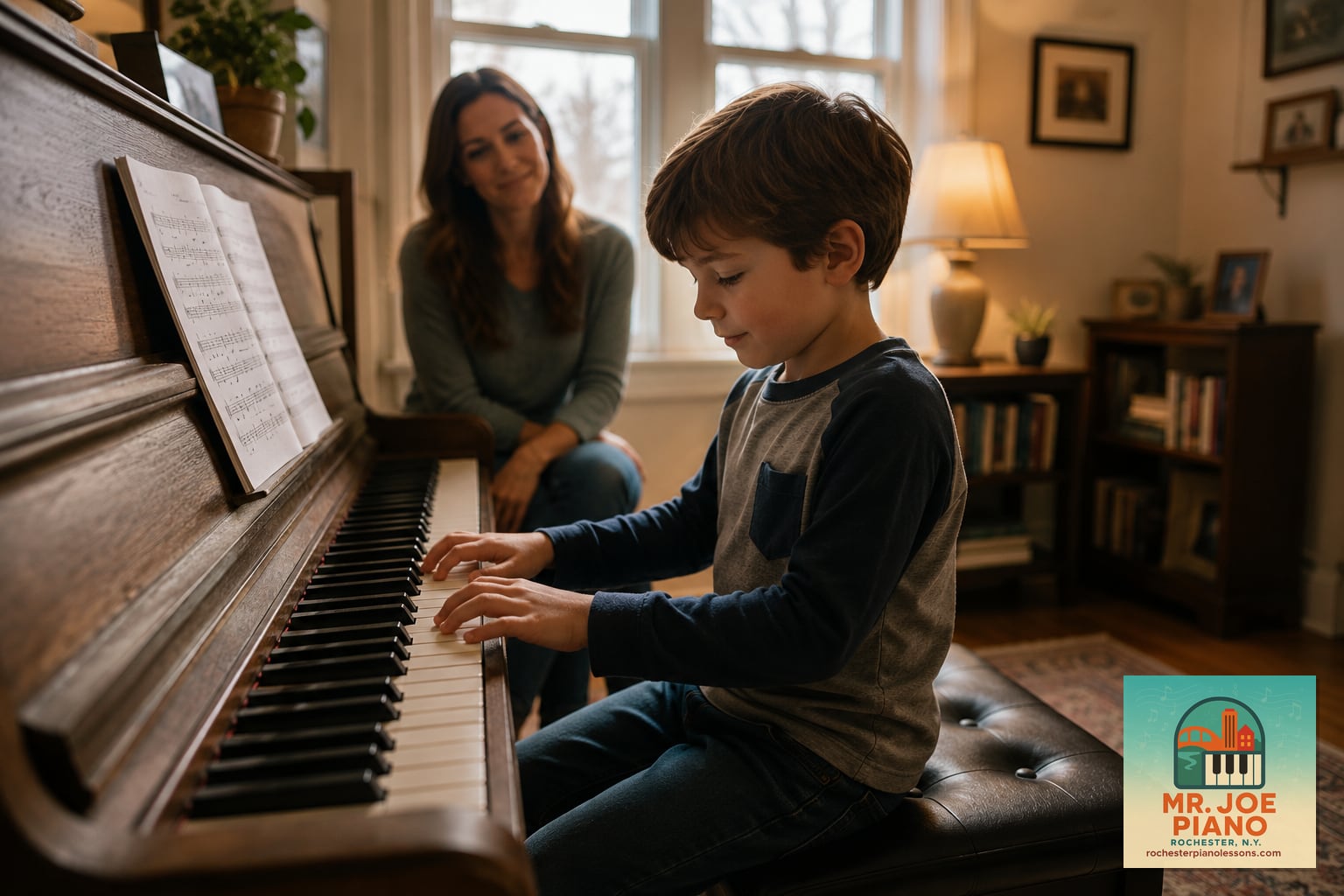
A lot of parents ask me what age kids should start piano lessons.
The honest answer is that there is no perfect age for every child. Some kids are ready around 5. A lot of kids are ready around 6 or 7. Some do better if they wait a little longer.
My simple answer is usually this:
If a child can say their ABC's and sit still for short amounts of time, they can probably start piano.
That does not mean they are going to sit perfectly for 30 minutes like a little adult. That is not realistic, especially for younger kids. But if they can follow simple directions, pay attention in small chunks, and show some interest in music, then piano lessons may be worth trying.
Age matters, but readiness matters more.
Quick signs your child may be ready
Your child may be ready for piano lessons if:
- They can say their ABC's
- They can count a little
- They can sit still for short amounts of time
- They can follow simple directions
- They show some interest in music
- They can handle a few minutes of practice at home
They do not need to know anything about piano before starting. They do not need to read music. They do not need to know where middle C is.
That is what lessons are for.
A good starting age for many kids
For many children, age 6 or 7 is a good time to start piano lessons.
At that age, most kids can usually follow directions, recognize letters and numbers, sit for a short lesson, and understand that learning something takes a little practice.
But that is not a hard rule.
Some 5-year-olds are ready. Some are not. Some 8-year-olds are very ready because they are more focused and understand things more quickly.
I have taught enough students to know that kids do not all develop the same way. One child might be ready at 5. Another child might need another year. That is normal.
The goal is not to rush. The goal is to start when the child can have a good first experience.
What about kids 5 and under?
Some kids 5 and under can start piano lessons, but the expectations need to be right.
A 4- or 5-year-old beginner is usually not going to sit at the piano for 30 straight minutes and work through a method book like an older student. Lessons at that age need to move differently.
We take small breaks.
That might mean standing up for a minute, switching activities, clapping rhythms, drawing something quick, moving away from the bench for a moment, or just giving the child a second to reset.
That is not wasting lesson time. That is part of teaching younger kids.
If the lesson is too rigid, the child may shut down or get frustrated. If it is too loose, they will not learn much. So the balance matters.
Short focused activities, small breaks, and then back to the piano. That usually works much better than forcing a young child to sit still the entire time.
What I look for before starting a younger child
With younger students, I do not expect perfection.
I am looking for a few basic signs.
Can they say their ABC's?
Can they count a little?
Can they sit still for short amounts of time?
Can they follow a simple direction like "play this key" or "use this finger"?
Can they try something again without completely falling apart?
That is usually enough to begin.
A younger child does not need to already act like an older student. But they do need to be able to participate in small steps.
Signs your child may be ready for piano lessons
Here are a few things I look for when parents ask whether their child is ready.
They can sit and focus for a short time
A beginner does not need to sit perfectly still.
But they should be able to focus for short stretches, listen to a direction, and come back to the lesson after getting distracted.
For young beginners, lessons work best when we build in small steps. Play a little. Count a little. Listen a little. Try again. Take a short break if needed. Then come back to it.
That is normal.
They can follow simple directions
Piano lessons involve a lot of small directions.
Use finger 2. Find the group of two black keys. Play it again. Try it slower. Count to four. Listen to the sound. Look at the notes.
If a child can follow simple directions most of the time, that is a good sign.
They do not need to be perfect. They do need to be teachable.
They know letters and basic patterns
Beginning piano uses letters, numbers, high and low, left and right, up and down, loud and soft, and simple patterns.
That is why being able to say the ABC's is helpful. Piano notes use letter names, and students will start learning how those letters connect to the keys.
They do not need to fully understand all of that before lessons. But if they can recognize letters and patterns, they have a good starting point.
They show some interest in music
Your child does not need to be obsessed with piano before starting lessons.
Some kids are naturally drawn to the piano. Some like singing. Some like music from movies, games, church, or school. Some just like making sounds and figuring things out.
That is enough to explore it.
I would not force piano lessons on a child who clearly hates the idea. But if there is curiosity, it may be worth trying.
They can handle a little practice at home
Practice does not need to be long at the beginning.
For young beginners, even 5 to 10 minutes can help if it happens regularly.
The bigger issue is whether the family can make practice part of the routine. A young child usually will not manage practice completely on their own. Parents may need to remind them, sit nearby, or help them get started.
Parents do not need to know piano to help. Just helping the child get to the instrument consistently makes a big difference.
What if my child is older?
Older beginners can do great.
Some parents worry that if their child did not start at 5 or 6, they missed the window. I do not believe that.
I started piano when I was 12, so I am living proof that starting later is not a dealbreaker.
If your child is 9, 10, 11, 12, or older and wants to start, that is not a problem. In some ways, older beginners have advantages. They usually focus better, understand directions faster, and may already have stronger opinions about what kind of music they like.
Starting young can be good. But starting when the student is actually ready is better than starting too early and making the whole thing frustrating.
A motivated older beginner can make real progress.
Piano is a gateway instrument
I often call piano a gateway instrument.
It is one of the best places to start because it helps students understand music in a visual way. The notes are laid out clearly. You can see patterns. You can play melody, harmony, rhythm, chords, and bass lines all on one instrument.
Even if a student eventually moves to guitar, voice, drums, violin, songwriting, production, or another instrument, piano gives them a strong foundation.
A lot of music theory makes more sense at the piano.
There is a reason many college music majors have to be proficient at piano or take piano classes. Even if piano is not their main instrument, it helps them understand music better.
That does not mean every child who starts piano has to become a serious musician. Most students are not thinking that far ahead. But piano gives them tools they can use in almost any musical direction later.
Why piano works well as a first instrument
Piano is a good first instrument because students can get a sound right away.
They press a key and it works.
They do not have to build up calluses like guitar. They do not have to learn bow control like violin. They do not have to develop breath support like a wind instrument.
That makes piano less frustrating in the very beginning.
It also gives students a clear way to understand notes, rhythm, chords, and patterns. The keyboard is laid out in a way that makes music easier to see.
That is a big reason I like piano as a starting instrument for kids.
What parents should not worry about too much
Some parents think their child has to be completely ready before starting lessons.
They do not.
Your child does not need to already read music. They do not need to know piano terms. They do not need perfect rhythm. They do not need to sit like a statue. They do not need to be some kind of prodigy.
They need to be able to try.
That is the main thing.
If they can listen, try, repeat small steps, and handle a little practice at home, that is a good start.
What you need at home
Before starting lessons, your child needs something to practice on.
An acoustic piano is great, but a good digital piano can also work. The main things I look for are full-size keys and a realistic feel.
A tiny toy keyboard usually becomes a problem pretty quickly. It might be fun to play around with, but it is not the best long-term practice instrument.
If you are not sure what to buy, ask before spending money. It is better to choose something useful than to buy something cheap and outgrow it right away.
Why in-home lessons can help younger students
For many Rochester families, in-home piano lessons in the Rochester, NY area make the whole process easier.
The student is already home. The instrument is right there. Parents do not have to drive across town, sit in a waiting room, and drive back. Lessons can fit into the weekly routine more naturally.
For younger kids, being in their own home can also make the first few lessons feel less intimidating.
Some kids are shy at first. That is normal. Being in a familiar place can help them settle in.
The first goal is a good experience
The first goal of piano lessons should not be pressure.
Yes, students need to learn. Yes, practice matters. Yes, there should be structure.
But especially with young beginners, the first goal is to help them feel comfortable at the piano and build confidence one step at a time.
A good first experience matters.
If lessons feel too heavy right away, some kids shut down. If lessons are too loose, they do not learn much.
The right balance is patient, clear, structured, and still enjoyable.
Still have questions?
If you still have questions about pricing, practice, missed lessons, or how the free meet-and-greet works, you can also read the piano lesson FAQ.
So what age should kids start piano lessons?
For many kids, age 6 or 7 is a good starting point.
Some kids can start at 5. Some are better off waiting until 8 or older. Older beginners can do very well too.
The simple answer is this:
If your child can say their ABC's, sit still for short amounts of time, follow simple directions, and show some interest in music, they may be ready to start piano lessons.
Want to see if your child is ready?
Mr. Joe Piano offers in-home piano lessons in the Rochester, NY area for kids, teens, and adults.
The free meet-and-greet lesson is a simple first step. It gives us a chance to meet, talk about your child's age, experience, goals, location, and schedule, and see whether piano lessons are a good fit right now.
If you are wondering whether your child is ready, the free meet-and-greet lesson is a good place to start.