
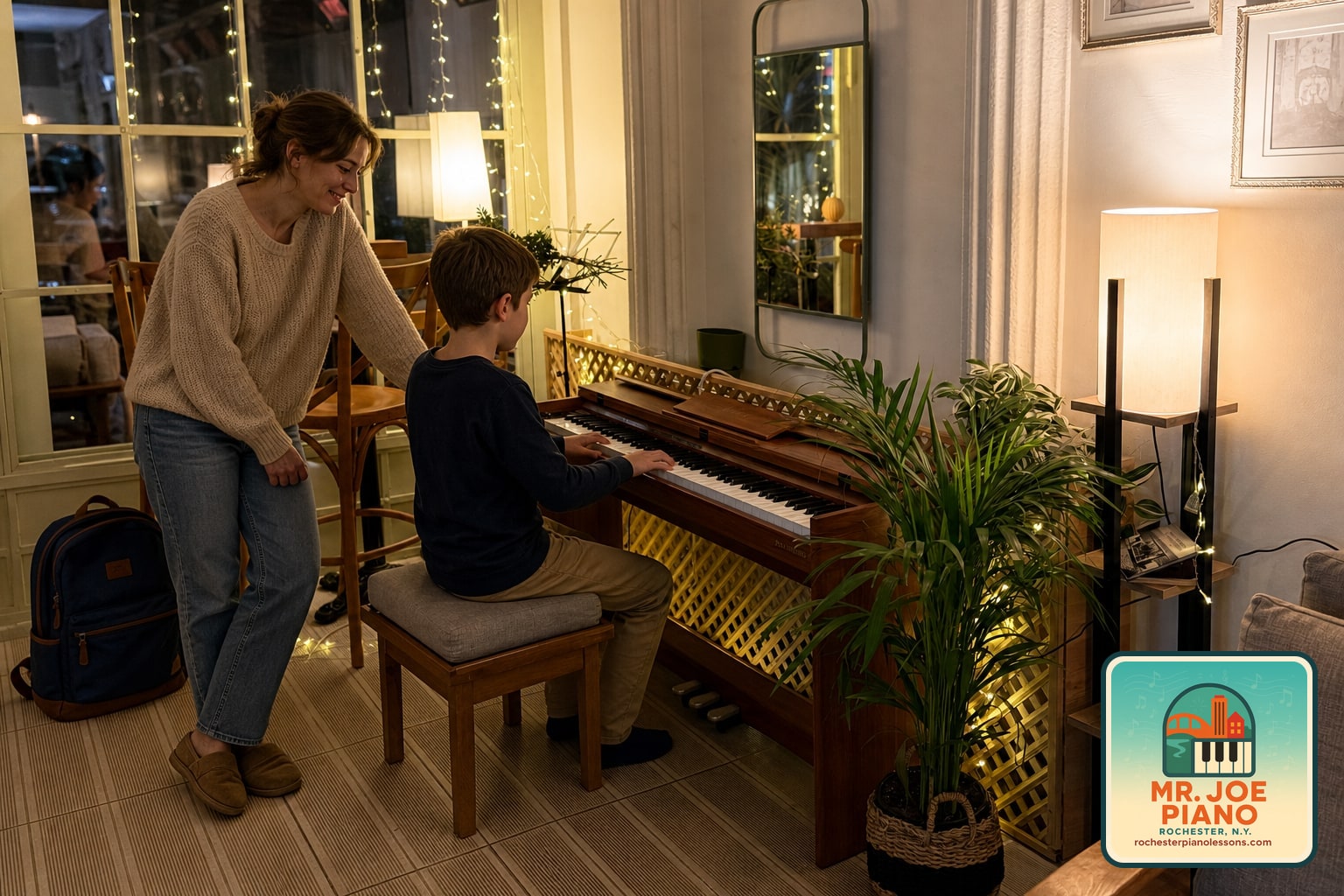
Once the school year gets moving, Rochester families get busy quickly. There is homework, sports, dinner, after-school activities, and plenty of driving from one side of town to the other.
Piano practice can easily become one more thing everybody feels guilty about.
It does not need to be that way.
A good practice routine should fit into your family's real week—not an imaginary week where nothing unexpected happens. I would rather have a student practice for a focused ten or fifteen minutes most days than struggle through one long session the night before the lesson.
Start with a realistic amount of time
Young beginners usually do not need to sit at the piano for an hour. In many cases, ten to fifteen focused minutes is a perfectly good place to start.
Older or more advanced students may need additional time, but the same principle applies: regular practice is more helpful than one big weekly session.
The first goal is to make sitting down at the piano feel normal. Once that habit is established, we can gradually build from there. If you want more age-by-age guidance, I also wrote about how much a child should practice piano.
Connect practice to something that already happens
"Practice sometime tonight" is easy to forget. A routine works better when piano follows something predictable:
- Right after getting home from school
- Before dinner
- After homework
- Before screen time
- While a parent is preparing dinner
The exact time matters less than having a consistent cue.
Every household has a different schedule. Some students play sports several nights a week. Some split time between two homes. Some parents do not get home until later.
We find a routine that works for that particular student instead of pretending every Rochester family has the same evening.
Give the student a clear assignment
Students are much more likely to practice when they know exactly what to do.
"Practice piano" is vague. A useful assignment might look more like this:
- Play the warm-up twice.
- Practice measures nine through sixteen slowly.
- Play the left hand by itself.
- Finish with a song you enjoy playing.
That gives the student a clear beginning, an end, and a sense of accomplishment.
During lessons, I make sure students understand what they are working on and why. They should not leave wondering what they are supposed to do all week.
Keeping assignments organized with Mr. Joe's Keystride app
I use Mr. Joe's Keystride app, a practice app I built myself, to keep track of each student's assignments.
Instead of relying on memory, a loose sheet of paper, or a quick conversation at the door, students and parents have one clear place to see what we are working on that week.
It also helps me follow each student's progress from one lesson to the next. I can see what I assigned, continue where we left off, and make sure the work stays appropriate for that student.
I built the app because I wanted something that fit the way I actually teach. It supports the personal part of piano lessons; it does not replace it. The purpose is simply to make assignments clearer and help students arrive at the next lesson prepared.
Do not turn every practice session into a battle
Parents should encourage the routine, especially with younger students, but they do not need to become the piano teacher.
A simple reminder is often enough: "It is piano time. Let's do ten minutes."
If a student is regularly stuck, frustrated, or confused by an assignment, tell me. That helps me adjust the material or explain it differently during the next lesson.
Practice should require some effort, but it should not create a nightly argument.
Keep the piano ready to use
The easier it is to begin, the more likely practice will happen.
Keep the books near the instrument, make sure the bench is in place, and avoid covering the keyboard with mail, laundry, or school supplies.
If the student has to clear a space and search for music every time, that becomes one more reason to put practice off.
One advantage of in-home piano lessons is that students learn on the same instrument they use during the week. I can help arrange the bench, music, and setup so practicing at home feels more comfortable.
Practice MOST days
I often tell students to practice MOST days.
That wording is intentional.
Consistency matters, but nobody needs to panic because Tuesday got away from them. Missing one day is not failure. We simply get back to the piano the next day.
Four or five focused practice days will usually do much more for a student than waiting for the one "perfect" evening when there is plenty of time.
A simple school-year practice plan
Here is a routine that works well for many beginners:
- Choose four or five likely practice days.
- Use the same general time whenever possible.
- Start with ten to fifteen minutes.
- Follow the assignment in Mr. Joe's Keystride app.
- Finish with something enjoyable.
- Adjust the routine if it is not working.
Try it for two weeks. If it does not fit, change the time or shorten the session.
A routine is only useful if your family can actually keep it.