
Parents ask me this all the time:
"How much should my child be practicing?"
It is a really good question. And honestly? The answer is not usually, "Make them sit there for an hour."
For most kids, especially when they are just starting out, I like to keep it simple:
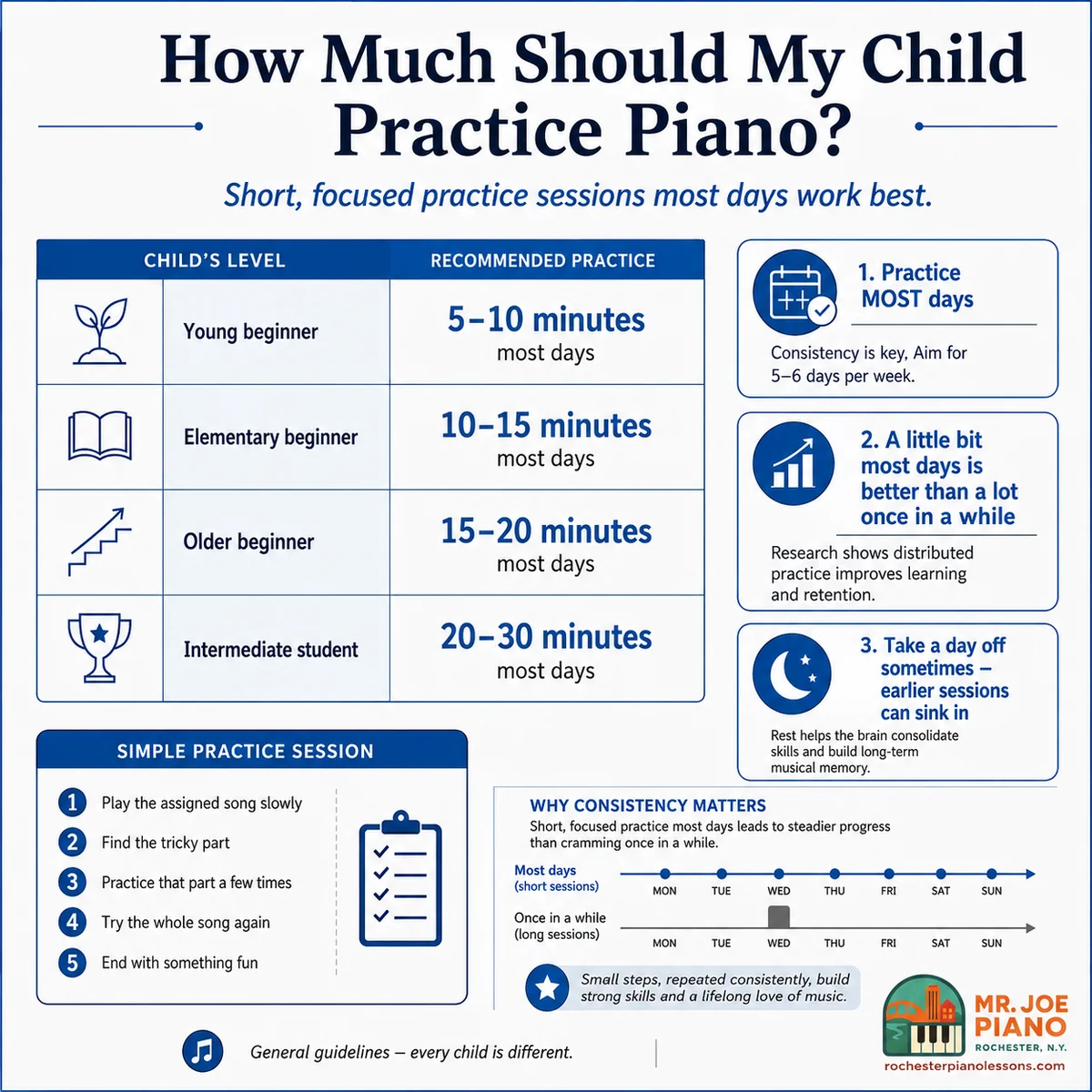
Practice MOST days.
Not every single day. Not perfectly. You do not need a stopwatch or some big fight at the piano bench.
Just most days.
That is usually enough to get the habit going, keep the music fresh in their head, and help your child actually make progress week after week.
A little bit most days is better than a lot once in a while
Piano practice works best when it is just a normal part of the week.
For a young beginner, that might only be 5 or 10 minutes. And that is totally fine. Five good minutes is still five good minutes.
A beginner does not need to sit at the piano forever. Actually, forcing really long practice sessions too early can make piano feel like punishment. And we definitely do not want that.
Here is a general idea of where to start:
| Age / Level | Practice Goal |
|---|---|
| Young beginner | 5-10 minutes most days |
| Elementary beginner | 10-15 minutes most days |
| Older beginner | 15-20 minutes most days |
| Intermediate student | 20-30 minutes most days |
These are just guidelines, not strict laws.
Some kids can do more. Some kids might need less to begin with. The main thing is just being consistent.
Take a day off
I tell my students this too:
Take a day off from practice. Let those earlier sessions really sink into your brain.
That might sound funny coming from a piano teacher, but it is true.
Sometimes kids just need a little space. Their brain is still working on the music even when they are not at the piano. A day off can keep things fresh and help prevent burnout.
The goal is not to fill the house with guilt around the piano.
It is to help your child keep coming back to it.
What should practice actually look like?
Practice does not have to be some huge, complicated thing.
For most beginner students, a simple practice session might look like this:
- Play the assigned song slowly.
- Find the tricky part.
- Play that tricky part a few times.
- Try the whole song again.
- End with something fun.
That last one? That really matters.
I like students to have something they actually enjoy playing. It could be an older song, a fun little pattern, or something they figured out by ear. Not everything at the piano needs to feel like homework, right?
A child who enjoys sitting down at the piano is going to make way more progress over time than a child who feels like piano is just another chore.
If you are still figuring out whether your child is ready for lessons, this guide on what age kids should start piano lessons may help too.
Parents do not need to be piano experts
Sometimes parents worry because they do not play piano themselves.
That is totally fine.
You do not need to know how to play piano to help your child practice. The biggest thing you can do is help them get into a routine.
You can just say:
"Let's do your piano for a few minutes."
That alone helps a lot.
You can also listen nearby, remind them to slow down sometimes, and remind them that mistakes are just normal. Try not to turn every wrong note into a big correction. Kids need room to figure things out on their own.
A calm parent nearby is usually way more helpful than a parent trying to be a second piano teacher.
I use a practice app with my students
I also use a practice app with my students so we can keep track of what they are working on during the week.
This helps out in a few ways.
It gives students a clear assignment. It helps parents know what to remind them about. And it helps me see how practice is going between lessons.
It is not about being super strict or making kids feel bad if they miss a day. It is just a helpful tool to keep everyone on the same page.
Again, the goal is:
Practice MOST days.
Not perfectly. Just consistently.
Avoid the practice battle
If piano practice turns into a daily fight, something needs to change.
Maybe the practice session is too long. Maybe the child is tired. Maybe the assignment just feels confusing. Maybe they just need a smaller goal.
For younger kids especially, two short sessions can work better than one long one. Even five minutes before dinner or after school can make a difference.
I would much rather have a child practice calmly for five minutes than sit at the piano angry for thirty.
That is not helping anybody.
For Rochester-area families, in-home piano lessons can also make practice more natural because the student learns on the same instrument they use during the week.
So how much is enough?
For many beginner students, 10 minutes a day, most days of the week, is a great place to start.
That may not sound like much, but it really adds up.
It keeps the child connected to the piano between lessons. When students do not touch the piano all week, every lesson feels like starting over. When they practice most days, even for a short time, the lesson has something to build on.
That is when you really start to see progress.
The simple answer
So, how much should your child practice piano?
Here is the simple answer:
Short, focused practice sessions most days. Take a day off when you need to. Keep it calm. Keep it consistent.
That is the sweet spot.
At Mr. Joe Piano, I help students and families build a realistic practice routine that fits the child's age, personality, attention span, and goals. Piano should be challenging, but it should also feel doable.
You can also read the piano lesson FAQ or see what local families have shared on the testimonials page.