
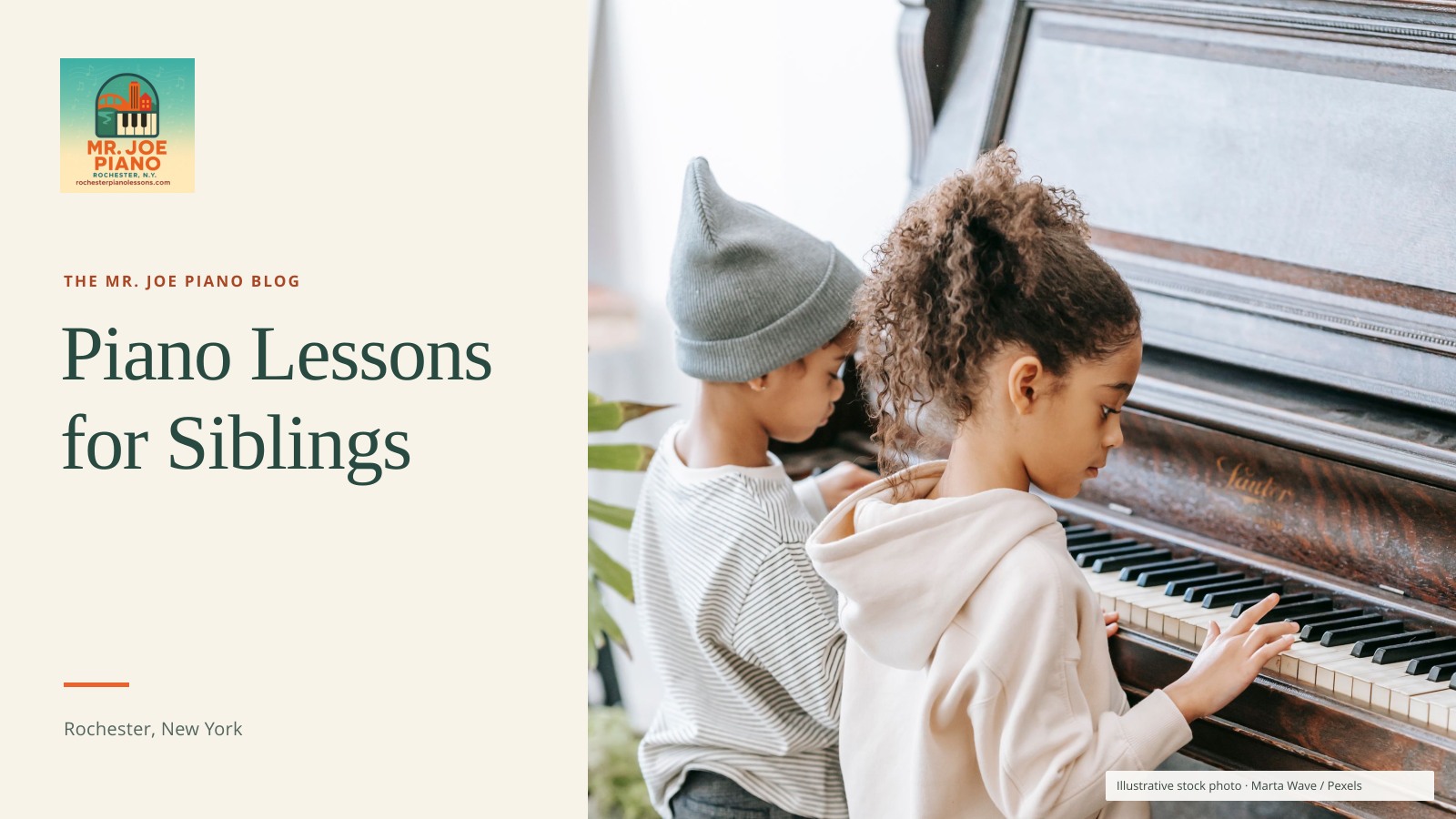
Maybe one of your kids has started piano, and now the other wants to try it too. Or maybe both have been asking about lessons, and you're wondering how this is going to work with one piano and an already busy week.
There are a few practical things to figure out. Who practices first? Do they need the same books? What happens if the younger one learns a song faster?
It helps to start by looking at each child separately.
They may learn very differently
Even if your kids start on the same day, they probably won't do everything at the same pace.
One might pick up a rhythm right away but need more help reading notes. The other might read well and need extra time getting both hands to work together. One wants to play a favorite song. The other wants to know what all the pedals do.
That's part of figuring out how each student learns. I want to see where they're comfortable, where they're getting stuck, and what we should work on next.
They may use different books or have different songs to practice. Finishing a book first doesn't tell the whole story, either. There's a lot more to learning piano than turning pages.
And they don't have to start lessons together. If one child is interested and ready to follow directions while the other mostly wants to explore the keyboard, it's fine to give the second child more time. I've written more about how to tell whether your child is ready for lessons.
Make lesson day a little easier
This is one situation where lessons at home can be especially helpful. You don't have to pack everybody into the car. Each child can have a turn at the piano without adding another trip to your week.
If you're hoping for back-to-back lessons on the same weekday, let me know when you inquire. We'll need to talk through what might work for your location and my teaching schedule.
Each child still needs time with the teacher. While one is having a lesson, have something ready for the other to do. A book, drawing, or homework might work, depending on their age and how much help they need.
Sometimes a sibling wants to listen. That's fine when it helps them enjoy the music. But if they're calling out answers or pointing out wrong notes, give the student at the piano a little space.
It's hard to try something new when your brother or sister is correcting you from across the room.
One piano, two practice turns
One suitable piano or keyboard can work for both children. The important thing is that each gets a chance to use it.
Pick a practice order before they both want the bench. Maybe one plays after a snack while the other starts homework, and then they switch. If the second child is always tired or rushed, change the order or find another time.
Keep their music and assignments easy to tell apart, and check the seat when they switch. A setup that feels comfortable for an older child may leave the younger one's feet dangling.
If you're unsure about the keyboard you already have, tell me the brand and model before buying another instrument. Here's my guide to what you need before starting lessons.
My usual advice still applies: practice MOST days. But both children don't need identical practice sessions. Follow each child's assignment rather than making them match minutes at the piano.
If they're arguing over whose turn it is, or one is always too tired when the bench is finally free, let me know. We can talk through a routine that gives each child a fair chance. For more on practice length, here's how much children should practice piano.
Be careful with comparisons
"Your sister already learned that one" can slip out pretty easily. But it doesn't help a child figure out the part they're struggling with.
Notice something in their own playing instead. "That part is sounding smoother." Or, "You kept going after that mistake."
There will be weeks when one child seems to move ahead quickly and the other spends more time on the same song. Let me know if that's bothering either of them. We can look at what they're working on and make sure the expectations make sense.
They can enjoy music together, too. Let them take turns playing something they like for the family. If they're interested in playing together, ask about a simple duet. They don't both have to be at the same level to enjoy making music in the same house.
Thinking about lessons for both kids?
I teach in-home piano lessons around Rochester. Tell me your children's ages, whether either has played before, your neighborhood, and which weekdays might work. Let me know what piano or keyboard you have, too.
You can ask about a free meet-and-greet, and we'll talk about the schedule and whether lessons look like a good fit. Bring your questions about both children. It's a chance to meet and see how lessons could work for your family.
You can also call or text me at (585) 478-3119.